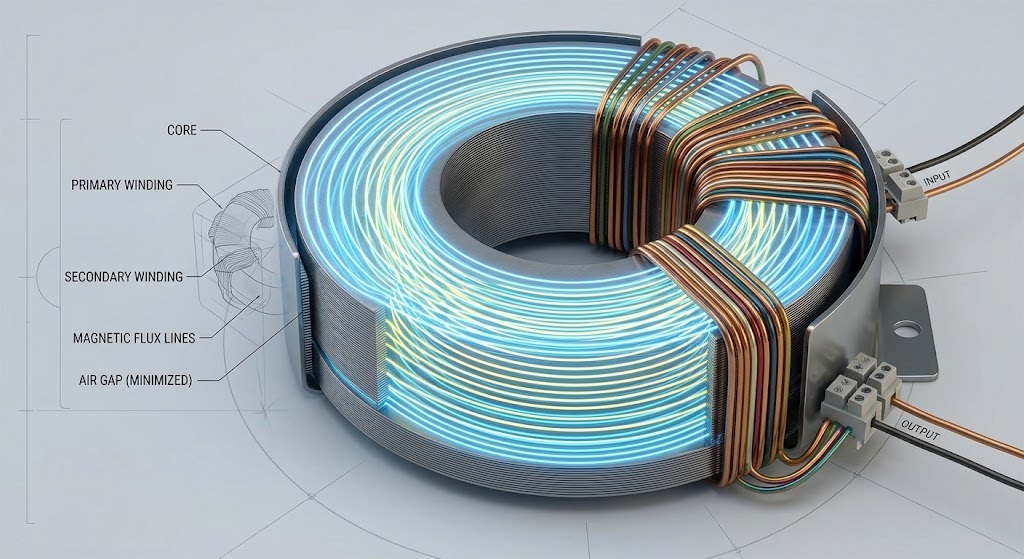
Toroidal transformers reduce noise through three key design features. Their donut-shaped core creates a closed magnetic path. Their windings are symmetrical. They have no air gaps. These traits work together to suppress both acoustic hum and electromagnetic interference.
A Low Noise Toroidal Transformer serves noise-sensitive applications. Audio amplifiers and DACs rely on this electrical transformer for clean power delivery. You will find these devices in recording studios and high-end listening rooms.
This article explains the working principle behind this noise-reduction advantage. You will learn how core construction and winding symmetry keep a toroidal transformer quiet. The design details matter for your next project.
Key Takeaways
A donut-shaped core keeps magnetic flux inside the transformer. This stops stray fields from causing interference.
Symmetrical windings cancel opposing magnetic fields. This reduces electromagnetic noise without extra shielding.
A continuous core without air gaps stops vibration. This makes toroidal transformers up to 8 times quieter than traditional types.
These design features deliver clean power for audio and medical equipment. You get quiet, efficient performance in a small size.
How Toroidal Transformers Reduce Noise
The Toroidal Transformer Working Principle
The working principle of a toroidal transformer starts with electromagnetic induction. An alternating current flows through the primary coil and generates a magnetic field inside the core. This changing magnetic field then induces a voltage in the secondary coil. This is the same working principle you find in any electrical transformer.
The toroidal shape changes how this process unfolds. A donut-shaped core creates a closed loop for magnetic flux. The flux travels in a continuous circle through the core material. This design keeps almost all magnetic flux inside the windings. Stray flux that escapes into surrounding space drops to roughly one-tenth of what EI transformers produce. You get efficient flux circulation with minimal leakage.
The operating principles here differ from traditional laminated designs. A solenoid or EI core lets flux leak through gaps and edges. A toroidal core contains the field within its circular path. This self-shielding behavior means you often need no extra shielding. The compact footprint also saves space on your circuit board.
Toroidal transformers are known for their high efficiency, typically ranging from 95% to 99%. This high efficiency is due to their near-ideal design, which effectively contains the magnetic flux within the windings, eliminating leakage flux.
Symmetry and Field Cancellation
Symmetry plays a central role in noise reduction. The windings on a toroidal transformer distribute evenly around the circular core. This arrangement creates a balanced electromagnetic structure. The operating principles of field cancellation depend on this symmetry.
Consider how current flows through the windings. Radial current segments at equal distances from the axis point in opposite directions. These opposing currents cancel each other out. Axial current on the outside of the toroid flows downward. Axial current on the inside flows upward. Each outer segment matches an equal but oppositely directed inner segment. The net effect on the external magnetic field cancels completely.
This cancellation produces a remarkable result. The magnetic B-field outside the windings drops to zero. Ampere's circuital law confirms this outcome. No current is enclosed by any flux circle outside the winding. The field stays confined within the core. You get total internal confinement of the magnetic field.
The working principle behind this effect relies on axial symmetry. Conductors and magnetic material arrange symmetrically around the axis. No circumferential current exists. Magnetic flux lines form circles of constant intensity centered on the axis. Only flux circles inside the toroidal winding enclose any current. This is why external magnetic fields cancel so effectively.
Common-mode noise suppression also benefits from this design. Toroidal cores maximize magnetic coupling for common-mode signals. They minimize effects on differential signals. This improves noise control across target frequency ranges. The operating principles of symmetry and cancellation work together. They reduce external interference without bulky shielding.
For your noise-sensitive application, this means cleaner power delivery. The Toroidal Transformers design keeps electromagnetic interference contained at its source.
The Toroidal Core Advantage
Tight Core Construction and Windings
The core material in a toroidal transformer comes as ferrite, laminated silicon steel, or another ferromagnetic substance. Manufacturers wind this material into a continuous tape. The process produces a solid, one-piece core with no joints. You get a mechanically rigid structure.
A winding machine places copper wire evenly around the entire core circumference. This uniform coverage uses less total wire than traditional laminated designs. Shorter wire means lower resistance in the windings. Lower resistance directly improves power transfer efficiency. You also achieve higher energy efficiency because less power turns into heat.
The fill factor for toroidal windings typically falls between 20% and 60%. Most applications land in the 35% to 40% range. This high fill factor means the windings fill more of the available window area. The compact arrangement further reduces resistance. A toroidal transformer delivers more usable power per unit of wire than an equivalent EI type.
The Critical Absence of Air Gaps
Traditional EI core transformers have air gaps between their stacked laminations. These gaps interrupt the magnetic path. A toroidal core has no such gaps. The magnetic flux flows in a continuous loop without interruption. This continuous path keeps the magnetic circuit complete.
Audible hum in transformers comes from vibration of windings and core layers. Forces between coil turns and core laminations cause this vibration. In toroidal construction, the core is tightly wound, spot welded, annealed, and sometimes epoxy coated. This construction suppresses vibration effectively.
The absence of air gaps directly contributes to quieter operation. Toroidal transformers achieve this noise reduction because of their smooth flux path. Here is a direct comparison:
Factor
EI Core Transformer
Toroidal Transformer
Noise Result
Core construction
Stacked laminations with air gaps
Continuously wound core without gaps
Toroidal is quieter
Magnetostriction
Higher because of corners and gaps
Lower because of a smooth flux path
Toroidal is quieter
Structural rigidity
Moderate
Very high
Toroidal is quieter
Corners and stress points
Present
None
Toroidal is quieter
Vibration transmitted to enclosure
Higher
Lower
Toroidal is quieter
Overall audible noise
Higher hum
Up to 8 times quieter
Toroidal is quieter
The consistent construction and lack of air gaps reduce magnetic flux spreading. This reduction in fringing also minimizes noise. A Low Frequency Toroidal Transformer uses this design for quiet operation in sensitive industrial environments.
For your application, these features matter. The tight core and gapless magnetic path work together. You get a transformer that runs quietly and with high efficiency. This also means you save on operating costs over the equipment lifetime.
Noise Reduction Advantages
Reducing Acoustic Noise and Vibration
Magnetostriction is the physical vibration that causes acoustic hum in any electrical transformer. As the core expands and contracts with each AC cycle, it produces a faint buzz you can hear in quiet rooms. Tight core construction dampens this effect. A toroidal core is wound continuously, then spot welded, annealed, and often epoxy coated. This rigid structure resists the dimensional changes that magnetostriction tries to force on it. The result is a transformer that runs up to 8 times quieter than an equivalent EI type.
You also benefit from the absence of air gaps. Gaps between stacked laminations act as stress points where vibration concentrates. A gapless core spreads mechanical stress evenly around the ring. The windings sit tightly against the core, so they cannot rattle independently. For audio gear, this means no audible hum bleeding into your signal path.
Minimizing Electromagnetic Interference
The closed magnetic path keeps stray flux away from surrounding circuits. Field lines stay confined inside the core instead of radiating outward. This containment sharply reduces magnetic leakage. Nearby traces and components therefore pick up far less induced noise. A toroidal transformer naturally shields adjacent circuits and lowers the need for extra EMI shielding.
Compare this behavior with boxed designs. E-I or C-core transformers have gaps at the ends of their cores. Magnetic field spills out at these gaps. Engineers must add bulky laminations or external shields to control that leakage. A toroidal core has no air gaps, so nearly all magnetizing energy remains inside the core. This is why toroidal units minimize external magnetic field radiation and reduce mutual coupling to adjacent traces.
The numbers back this up. Toroidal transformers emit EMI at roughly 10 percent of the level from traditional laminated transformers. That equals a 90 percent reduction compared to standard EI types. You get low electromagnetic radiation without adding heavy shielding cans.
An electrostatic shield pushes performance further. A typical shield gives about 60 dB of common mode noise attenuation across the 100 Hz to 1 MHz range.
A typical electrostatic shield gives about 60 dB of common mode noise attenuation over the frequency range of 100 Hz to 1 MHz.
These traits make toroidal transformers ideal for audio equipment. Preamplifiers, DACs, and power amplifiers all need clean rails. Any hum coupled onto a signal trace becomes audible at the speakers. A low noise toroidal design keeps that interference at the source. The same logic applies to measurement gear and medical instruments, where a stray field can corrupt a reading. When you need quiet power, the toroidal transformer delivers it through geometry and construction rather than brute-force shielding.
Sensitive Applications
Clean Power for Audio and Medical Equipment
Audio gear demands a power supply with minimal noise. Preamplifiers, DACs, and power amplifiers all need clean voltage rails. Any hum or ripple that leaks into the signal path becomes audible through the speakers. A standard laminated transformer often introduces this noise through stray magnetic fields and core vibration. A toroidal transformer eliminates both problems with its closed magnetic path and rigid construction. You get a power source that does not corrupt the audio signal. Recording studios and high-end listening rooms consistently choose this design for that reason.
Medical equipment places even stricter requirements on power quality. Devices such as MRI machines and ECG monitors rely on a stable low-noise supply to produce accurate results. Power-line noise or electromagnetic interference can distort measurements and affect patient safety. A toroidal unit meets this challenge by suppressing electrical noise and protecting against AC transients. The key advantages include lower leakage current, reduced electromagnetic interference, smaller size, and quieter operation. These features help manufacturers comply with the following safety standards:
Standard
Edition
UL 60601-1
2nd Edition
ANSI/AAMI ES60601-1
3rd Edition
IEC 60601-1
3rd Edition
ISO 9001:2015
Manufacturing standard
Toroidal transformers provide low acoustic noise by suppressing electrical noise and protecting against AC transients, delivering clean and stable power that is critical for precision equipment such as MRI machines and ECG monitors.
The low audible noise of this design also contributes to a quieter environment in patient rooms and clinical settings. You benefit from both electrical and acoustic silence.
The Role of a Low Frequency Toroidal Transformer
A low frequency transformer serves applications that operate at 50 or 60 Hz. These include industrial automation, power distribution, and renewable energy systems. The toroidal shape allows these units to achieve an efficiency of 90% to 95% at line frequencies. Standard laminated transformers rarely exceed 90% efficiency. The difference means you waste less energy as heat and save on operating costs over the equipment lifetime.
The compact size and low weight of a toroidal transformer also matter in tight enclosures. You can fit more power into a smaller footprint without sacrificing noise performance. The gapless core and symmetrical windings keep electromagnetic interference low even in dense circuit layouts. For sensitive industrial applications where reliability matters, this design provides clean efficient power without adding hum or heat to the environment.
Three design features explain why toroidal transformers reduce noise so well. The closed magnetic path keeps flux inside the core. Tight construction dampens vibration and acoustic hum. Symmetrical windings cancel opposing fields and stop external interference.
These features work as a system. The gapless core removes stress points. The rigid build resists magnetostriction. The balanced windings contain stray flux. Together they cut both audible hum and electromagnetic noise at the source.
You get cleaner power with less shielding and a smaller footprint. For any application where noise is critical, these design advantages make Toroidal Transformers the superior choice. A toroidal transformer simply delivers quieter, more efficient performance.
FAQ
Why do toroidal transformers produce less hum than EI types?
The core has no air gaps. A continuous magnetic path stops the vibration that creates audible hum. Tight construction holds the windings in place. You get a unit that runs up to 8 times quieter than a standard laminated design.
Can I mount a toroidal transformer near sensitive audio circuits?
Yes. The closed magnetic path keeps stray flux inside the core. External fields cancel through winding symmetry. This design emits far less electromagnetic interference than an EI type. You often need no extra shielding for preamplifiers or DACs.
Does core material affect noise performance?
Yes. Ferrite, laminated silicon steel, and other ferromagnetic materials all work. The continuous winding process matters more than the material choice. A gapless core and even winding coverage deliver the noise reduction you want.
What causes acoustic noise in a transformer?
Magnetostriction makes the core expand and contract with each AC cycle. This movement produces a faint buzz. Air gaps and loose laminations amplify the effect. A rigid gapless core resists these dimensional changes and stays quiet.
Are toroidal units suitable for medical equipment?
Yes. Medical devices need stable low-noise power for accurate readings. These transformers suppress electrical noise and protect against AC transients. Their low leakage current and compact size suit MRI machines, ECG monitors, and other precision instruments.