Leave A Message
If you are interested in our products and want to know more details,please leave a message here,we will reply you as soon as we can.


A practical procurement guide by Foshan Risen Electric Co., Ltd.
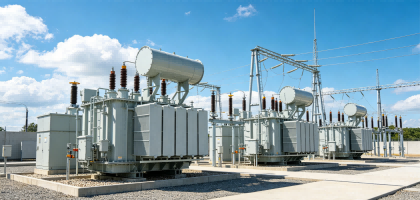
Across West and East Africa, the 33kV sub-transmission level is the backbone of regional power distribution. Utilities and EPC contractors step 33kV down to 11kV at regional substations, then feed distribution networks that supply industrial zones, residential areas, and commercial loads. Getting the specification right at this stage determines whether the substation performs for 25 years — or becomes a maintenance headache after three.
As a transformer sourcing and supply chain company, we receive inquiries for 33/11kV units every week from buyers across Africa and the Middle East. This guide distills what we check in every single inquiry, so you can approach your supplier with a specification that is complete, correct, and priced fairly.
The most common mistake we see is under sizing. Buyers specify for current peak load, and the substation hits its limit within 2–3 years.
● Calculate the current peak demand(kVA), not the connected load.
● Add 5-year load growth— typically 6–10% annually in fast-growing African distribution networks.
● Consider future feeders: if the substation will serve a new industrial park in 2 years, build that into the rating now.
Standard 33/11kV distribution transformer ratings include 5, 7.5, 10, 12.5, 15 and 20 MVA. Going up one step now costs far less than re-procuring later.
If in doubt, ask your supplier to explain the voltage profile implications for your specific feeder. A good supplier will recommend OLTC for long rural feeders even when it costs more, because a unit that cannot hold voltage is a unit that fails commercially.
This is the detail that gets skipped, and it shortens transformer life.
Provide the supplier with the site's ambient temperature profile, not just "hot climate". The correction is engineering, not guesswork.
A supplier who cannot show traceable routine test data for previous units is a supplier to be cautious about.
Step 5: Plan cooling, enclosure, and installation
1. What is the firm lead time, in writing, and what happens if it slips?
2. Can I receive the routine test reports before shipment?
3. What derating assumptions were used for my site's ambient temperature and altitude?
4. What warranty applies, and how are claims handled internationally?
5. What documentation ships with the unit (invoice, packing list, certificate of origin, test reports)?
Global transformer lead times in 2026 are running at 30–50 weeks. A supplier with real factory capacity and a coordinated supply network can make the difference between a project delivered on schedule and a project delayed a year.
How we work with buyers on these projects
Foshan Risen Electric operates as a sourcing and supply chain partner: we qualify and audit specialized transformer factories across China's manufacturing hubs (Jiangsu, Zhejiang, Hebei), match your specification to the right facility, monitor production through a four-stage QC protocol (IQC/IPQC/FQC/OQC), and manage pre-shipment inspection and export documentation.
When you send us your load data and site conditions, our engineering team returns a technical review and a quotation within 24 hours — with the derating assumptions, test plan, and lead time spelled out. No off-the-shelf compromise, no vague "market price" quotes.
Get a technical quotation here!
Q1: What is the typical voltage ratio at a regional substation in Africa?
A: The most common sub-transmission level in English-speaking African markets is 33kV, stepped down to 11kV for distribution or 0.415kV for LV supply, per IEC 60076.
Q2: When does a 33/11kV transformer need an on-load tap changer?
A: When the 33kV feeder is long or voltage varies significantly between day and night. On stable urban feeders, off-load tap changers may be acceptable at lower cost.
Q3: What test reports should a buyer request?
A: Full IEC 60076 routine test reports: winding resistance, turns ratio, impedance voltage, dielectric, induced over-voltage, no-load and load loss. Request them before production begins.
Q4: How long does a 33/11kV unit take to deliver in 2026?
A: With a coordinated multi-facility supply network, we quote 8-10 weeks for this class — well under the 30–50 week global average for transformer deliveries this year.