When designing or upgrading an electrical network, one of the most heavily debated engineering decisions is selecting the appropriate cooling technology. The choice between liquid-filled and solid-state equipment fundamentally alters your facility's safety protocols, architectural layout, and long-term maintenance budgets. While both technologies effectively step voltage up or down, their distinct thermal management systems make them suitable for entirely different operational environments. In this comparative guide, we will dive deep into the technical advantages, safety constraints, and Total Cost of Ownership (TCO) of both technologies to help you choose the ideal electrical grid transformer for your infrastructure.
1. The Science of Heat Dissipation: Liquid vs. Air
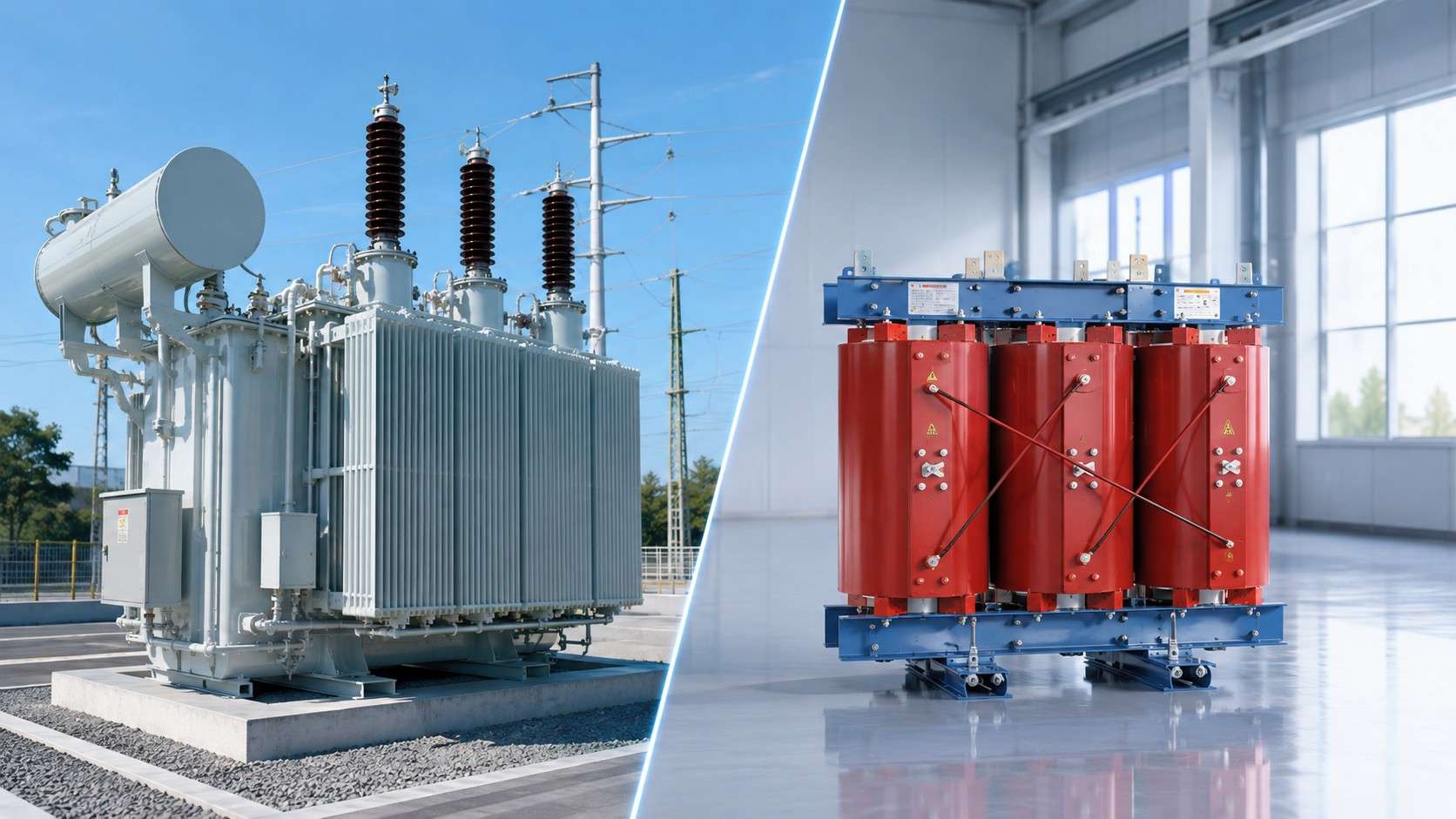
Heat is the natural byproduct of electrical resistance in copper or aluminum windings. How a unit dissipates this heat defines its core classification. An oil-immersed power transformer submerges its core and coils in a sealed tank of highly refined mineral oil or synthetic dielectric fluid. This liquid is an exceptional thermal conductor, absorbing heat and circulating it through external radiators via natural convection or forced pumping. This allows them to manage massive power loads in compact footprints.
In contrast, a dry-type cast resin transformer relies entirely on ambient air for cooling. The active windings are vacuum-cast in solid epoxy resin, which provides high dielectric strength and mechanical rigidity. Heat is dissipated directly from the surface of the resin into the surrounding air, often assisted by automated cooling fans (AF). Because air is a less efficient thermal conductor than oil, these units are generally larger in physical size for the same kVA rating compared to their liquid-filled counterparts.
2. Fire Safety and Site Location Constraints
The installation location is often the ultimate deciding factor. Because traditional insulating oil is combustible, liquid-filled units pose a significant fire and environmental spill hazard. Building codes strictly regulate their indoor use, typically requiring expensive fire-rated concrete vaults, blast walls, and fluid containment basins. Therefore, they are predominantly deployed outdoors in utility substations, renewable energy farms, and open-air industrial plants.
This is exactly where the solid-state dry-type transformer excels. The epoxy resin used in cast-coil units is inherently non-flammable, self-extinguishing, and produces zero toxic emissions during a thermal event. They require no liquid containment catchments. This unparalleled safety profile makes them mandatory for high-density indoor environments, including commercial skyscrapers, underground rail networks, data centers, and hospital infrastructure.
3. Overload Capacity and Thermal Inertia
Industrial grids often experience sudden load spikes (e.g., starting heavy motors). Liquid-filled units possess incredible "thermal inertia." The large volume of oil takes a long time to heat up, allowing the oil-cooled industrial transformer to safely handle substantial temporary overloads without degrading the winding insulation. Solid-state cast resin units heat up much faster due to the lack of a liquid buffer. While they can be equipped with forced-air fans to temporarily boost capacity by up to 30%, their baseline tolerance for sustained severe overloads is lower than that of liquid-filled designs.
Quick Comparison: Technical & Operational Metrics
Use this side-by-side comparison to quickly evaluate which technology aligns with your facility's operational demands.
Performance Metric
Oil-Immersed Technology
Cast Resin (Dry-Type) Technology
Primary Environment
Outdoor substations and harsh industrial yards.
Indoor commercial, residential, and high-safety zones.
Fire & Leak Hazard
High. Requires strict fire suppression and leak containment basins.
Zero. Self-extinguishing materials with no fluid to spill.
Peak Load Tolerance
Excellent thermal inertia for handling sustained overloads.
Good, but strictly reliant on cooling fans during overloads.
Routine Maintenance
High. Requires periodic oil sampling (DGA), filtering, and seal checks.
Minimal. Only requires routine dust removal and visual inspections.
Initial Capital Cost
Generally 15% to 30% lower purchase price.
Higher purchase price, but drastically lowers civil engineering costs.
4. Maintenance Regimens and Total Cost of Ownership (TCO)
When evaluating the budget, purchasing managers must look beyond the initial invoice. Liquid-filled units typically have a lower upfront purchase price. However, their maintenance regimen is rigorous. Facility operators must conduct annual Dissolved Gas Analysis (DGA) on the oil, check for tank corrosion, and monitor fluid levels. Over a 25-year lifespan, these labor-intensive maintenance costs add up significantly.
On the other hand, the cast resin dry-type transformer is essentially a "fit-and-forget" solution. Because there are no fluids to test, filter, or replace, maintenance is virtually reduced to occasional vacuuming of dust from the coils and tightening of terminal connections. When you factor in the savings from avoiding fire-vault construction and eliminating oil maintenance, the solid-state solution often delivers a vastly superior Total Cost of Ownership for commercial and indoor industrial applications.
FAQ
1. Can oil-immersed transformers be used safely indoors?
Yes, but only under extremely strict building codes. Indoor installation requires the construction of specialized fire-rated concrete vaults, automatic fire suppression systems, and leak containment trenches capable of holding 100% of the unit's fluid volume. This heavily inflates installation costs, which is why dry-type units are preferred indoors.
2. Are dry-type transformers louder during operation?
Generally, yes. The solid epoxy resin encapsulation tends to transmit core vibration (magnetostriction) more readily than liquid, which acts as a sound dampener. Additionally, if the dry unit relies on forced-air cooling fans (AF mode) during peak loads, the acoustic noise level will increase. Proper acoustic enclosure design is necessary for highly noise-sensitive environments like hospitals.
3. Which technology is better for renewable energy like solar farms?
For large-scale solar and wind farms, liquid-filled units are overwhelmingly preferred. They offer the necessary high-voltage capacities, can withstand severe outdoor weather fluctuations, and are highly efficient at handling the variable load cycles generated by renewable energy sources.
Need expert engineering advice for your upcoming project?
Our dedicated technical team is ready to review your specific grid requirements, provide customized engineering proposals, and offer direct factory pricing tailored to your specifications.
Contact Our Engineers Today